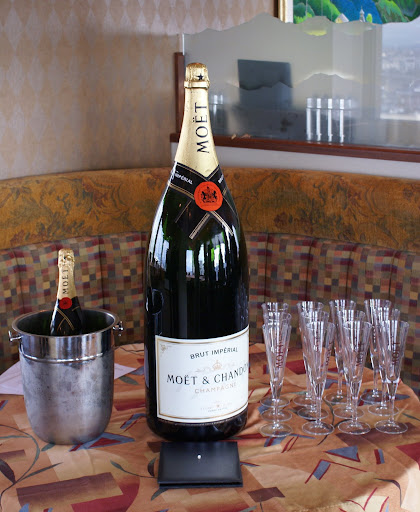
Will that be a Champagne, a Cava or a Crémant you will be drinking to celebrate the new Year? All of them made of course in the traditional method. Crémants are produced by adding a smaller dosage for the second fermentation, resulting in less carbon dioxide and thus a lower bottle pressure.This lighter effervescence creates a creamy texture to the wine and hence the term Crémant which means "creamy". Crémants have 2-3 atmospheres of pressure instead of 5-6 in wines from Champagne. My friend Philippe Durst, the Export Manager at Dopff Au Moulin in Alsace sent me this picture of a Crémant having some fun with a waitress.
But no matter what sparkler you will be celebrating with ( and I will be celebrating with a bubbly made here on Vancouver Island called Célébration Brut from Starling Lane Winery.)
it turns out that it is actually good for your heart.
My friend Nick Stephens over at Bordeaux-Undiscovered did a great post on that. And of course we all know that we should continue to drink our favourite beverage in 2010 because it is good for our health. Decanter has done a nice summation of the beneficial effects of wine. But only look at the green column. The researchers in the red column will be drinking and celebrating with a cup of decafinated tea.
Wishing you all a very Happy and Healthy 2010!!
After my first post on my Tuscan tour, I fully intended to share more about that marvelous trip. But I am detouring slightly to cover part of a previous trip. And thus I will make mention of my visit to the Champagne. Only because Harper Collins, the publishers in New York, send me a copy of the book The Widow Clicquot by Tilar J. Mazzeo to review. I had the pleasure of a private tour during the 2005 vendange, again with my friend Sanjoy from California, and with that background it made this book that much more meaningful.


The Champagne house of Veuve Clicquot Ponsardin is truly a must visit establishment and those of you who have been there will agree with this I am sure. The limestone cellars, which have been there since Roman times, are a treasure house of works of art. If you follow this link it will take you to the Veuve Clicquot website. There is an age verification before you can actually visit the site and just a little hint for those of you from Canada ( and yes we are a bilingual country) if you do not speak French, use the USA country of origin. The good people at Veuve have assumed if you are from Canada you must be able to speak French and the French version is what will present itself. We had a wonderful, knowledgeable young lady give us a most interesting tour and at the end of it, we had the pleasure of being served the La Grande Dame. Like Dom Perignon, I thought I was seeing stars.
The archives at the Veuve Clicquot Ponsardin reveal very little of the remarkable widow Clicquot. Their website gives only sparse details about this brilliant business woman. But Tylar Mazzeo has done an incredible amount of research for her book. Tylar is also very well versed in anything wine related and the book is liberally sprinkled with wine facts, especially about Champagne. For instance, did you know that in those early days, Champagnes were very sweet and had upwards of 200 to 300 grams of residual sugar? These are woven into the story and makes the history of the widow Clicquot come alive and the book almost reads like a novel and personal diary at the same time. This book is certainly a must read for all Champagne lovers out there. It is a tribute to the widow Clicquot Ponsardin and her marvellous determination and entrepeneurship. I believe Veuve Clicquot should host a major book signing event with Tilar Mazzeo present. She has contributed immensely to the story of the Veuve Clicquot with this fascinating, well written book. Publishers Harper Collins have just added another great book to their long list of excellent books.

 Will that be a Champagne, a Cava or a Crémant you will be drinking to celebrate the new Year? All of them made of course in the traditional method. Crémants are produced by adding a smaller dosage for the second fermentation, resulting in less carbon dioxide and thus a lower bottle pressure.This lighter effervescence creates a creamy texture to the wine and hence the term Crémant which means "creamy". Crémants have 2-3 atmospheres of pressure instead of 5-6 in wines from Champagne. My friend Philippe Durst, the Export Manager at Dopff Au Moulin in Alsace sent me this picture of a Crémant having some fun with a waitress.